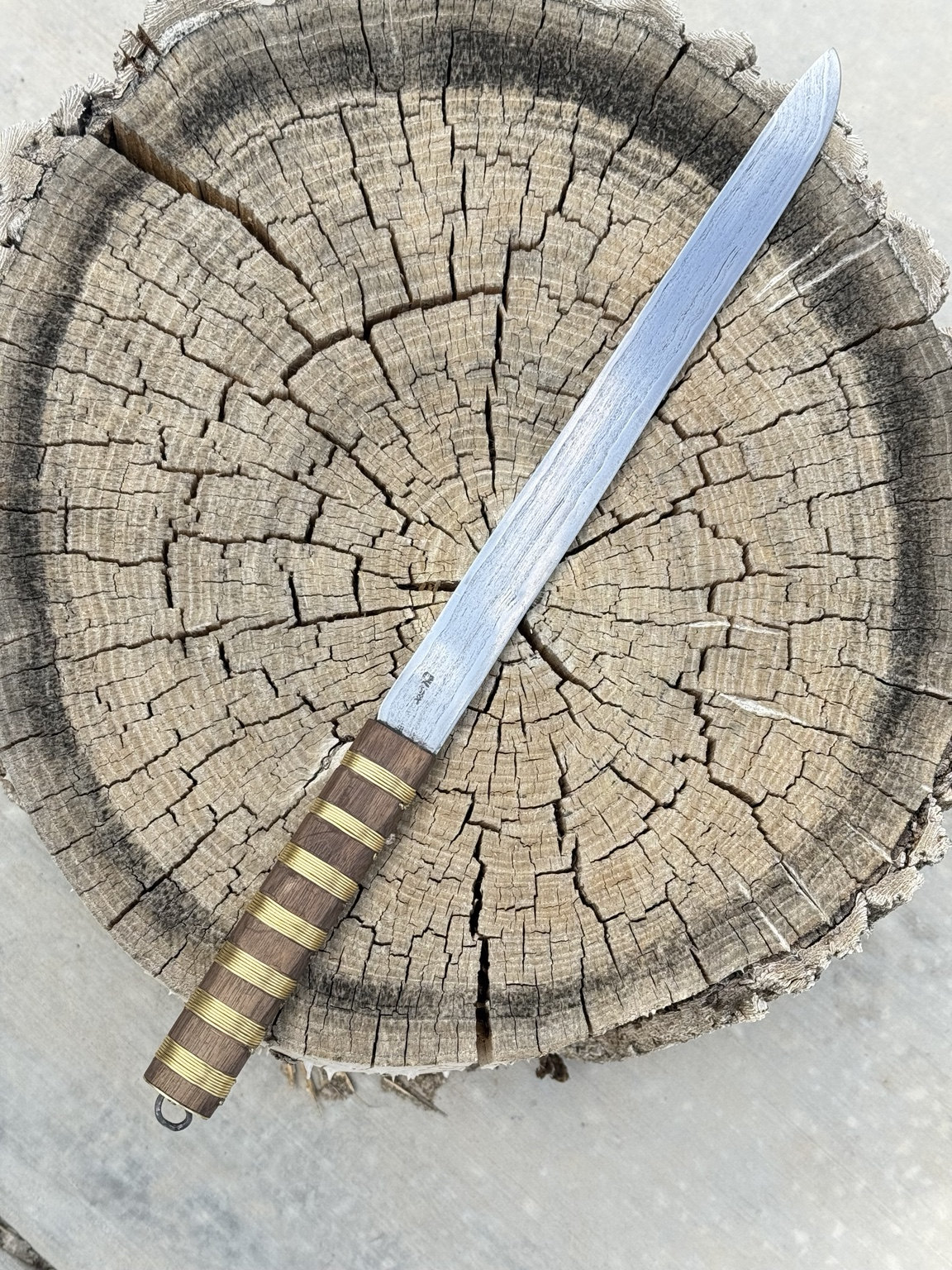
This knife began as a sword that did not survive the forging process. Rather than discard the remaining steel and wrought iron, I reforged the sound billet into a single-edged long knife inspired by Viking Age Scandinavian finds.
The finished knife was completed on .
From a failed sword to a long knife
The original sword billet consisted of three longitudinal bars: a wrought-iron core between two bars of 1084 high-carbon steel. The plan was to make a double-edged sword, closing the steel around the iron core at the point with a fish-mouth weld. That tip weld refused to set. After repeated attempts and cleanups, too much material had been lost for the intended sword. I removed the failed section and reshaped the usable remainder.
The change of direction was an opportunity to make a long knife for my historical kit. My SCA persona is a Varangian guardsman, and long knives associated with the eastern Scandinavian sphere interested me as a reconstruction subject. This example is not a copy of a single surviving knife; its proportions and handle details were informed by comparisons across several finds (Vlasatý, 2020, 2021).
Historical evidence and design
The research in my A&S documentation draws on Scandinavian long knives, particularly finds associated with eastern routes and sites including Šestovica, Gnězdovo, Timerevo, and Birka. The handle design takes inspiration from the wire-wrapped examples discussed by Vlasatý, including finds from Timerevo grave 348 and Birka grave 1130. The Šestovica long knife found in 2006 is a particularly relevant parallel for the decorated handle tradition (Vlasatý, 2020, 2021).
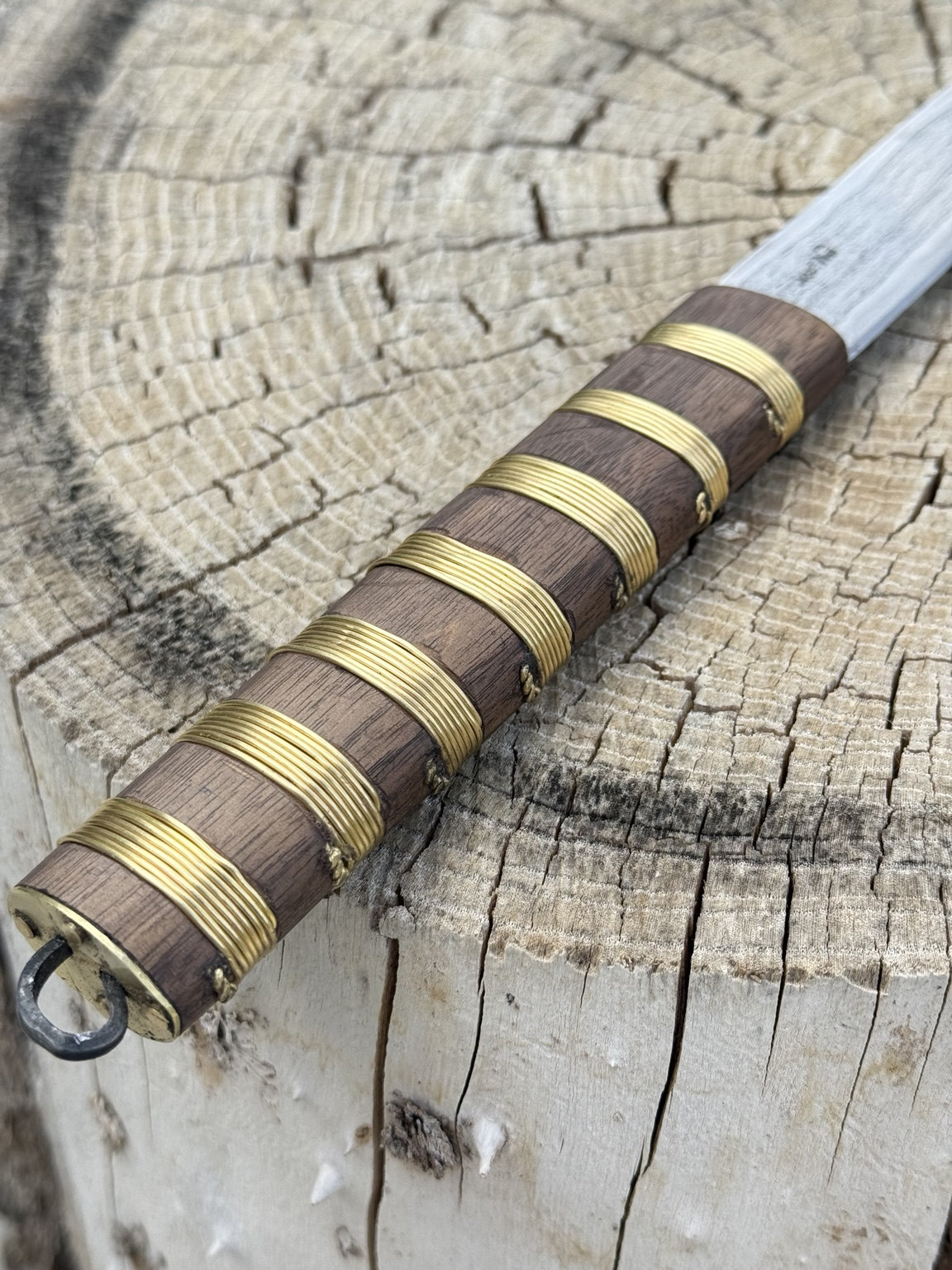
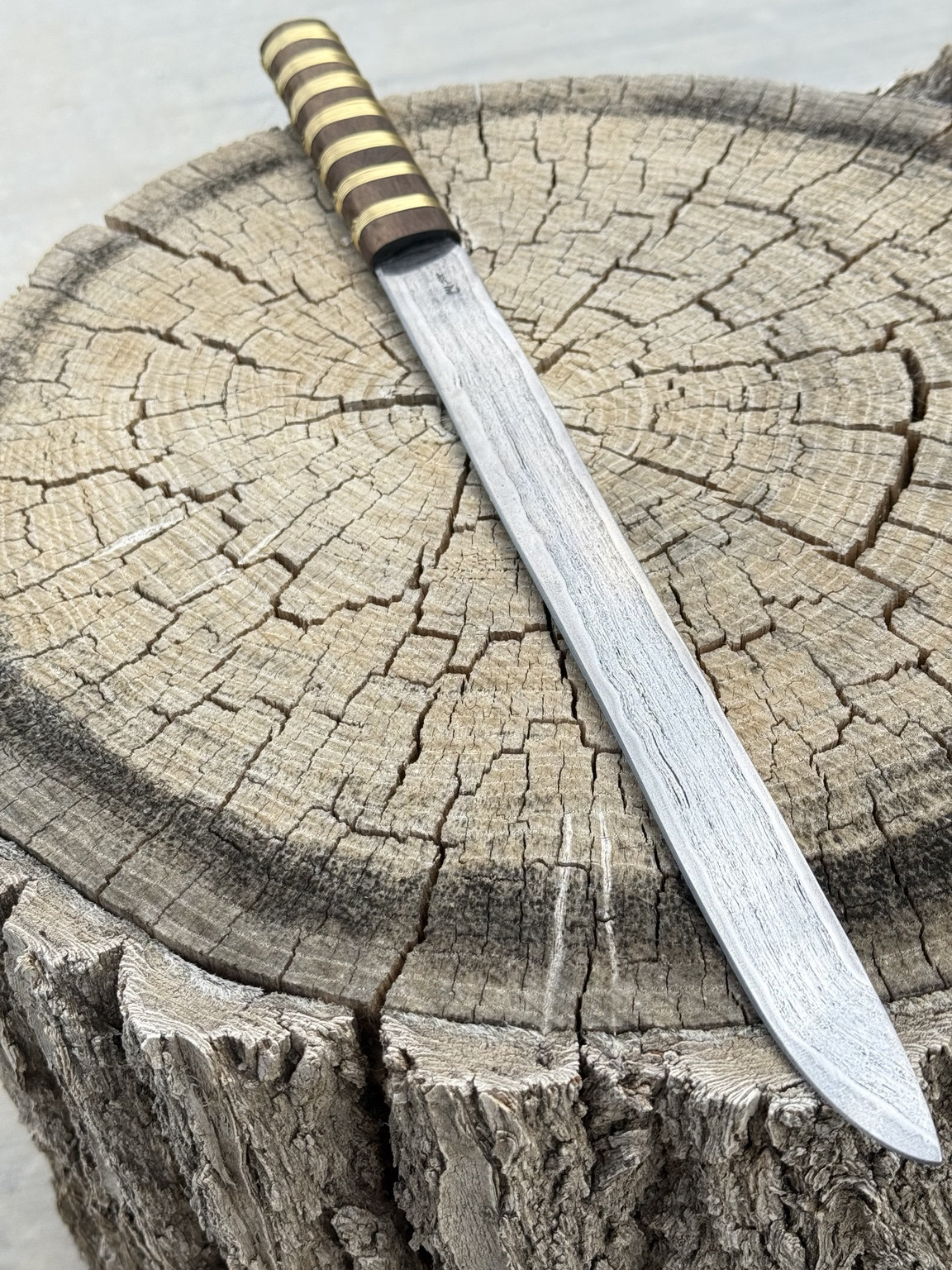
I used seven bands of brass wire sunk into notches in the oak grip, and added a metal end plate and iron suspension ring. The wrap technique was informed by advice from Götz Breitenbücher, who has examined surviving examples (personal communication, 2026).
Reconstruction approach: The dimensions compared below are ranges compiled from different archaeological finds, not measurements from one original knife. The finished piece includes deliberate and unplanned departures from those ranges.
Dimensions
| Measurement | My knife | Documented comparison range |
|---|---|---|
| Blade length | 325 mm | approximately 285–420 mm |
| Overall length | 480 mm | approximately 270–540 mm |
| Width at shoulder | 27 mm | approximately 18–38 mm |
| Spine thickness | 5 mm | approximately 7–13 mm |
| Handle length | 155 mm | approximately 90–130 mm |
The 155 mm handle is longer than the documented range. I chose that proportion because I preferred the appearance and feel. The 5 mm spine is thinner than the comparative range, a consequence of the material lost during the failed sword-tip welds and subsequent reforging. Neither difference should be mistaken for an exact historical match.
Materials and construction
Blade: Three-bar lateral lamination, with 1084 steel at the spine and edge and wrought iron between them. The arrangement was inherited from the planned double-edged sword. A hardenable steel spine is not necessary on a single-edged knife, and the source documentation identifies this as unusual for the knife form rather than typical period construction.
Forging: After removing the failed tip, I forged the tang first, then formed the point while the stock was thick and drew the blade and bevels to shape. Working wrought iron beside steel required attention to heat and hammer control; the iron responds differently and can tear along slag lines when worked too cold. Final shaping included grinding.
Handle and fittings: Oak core fitted to a through tang, with a brass end plate and brass rivets, an iron suspension ring, and seven recessed bands of 1.0 mm brass wire. Modern epoxy backs up the mechanically secured handle. The documented comparisons commonly use thinner wire, around 0.5–0.6 mm, although the research includes examples up to 1.0 mm.
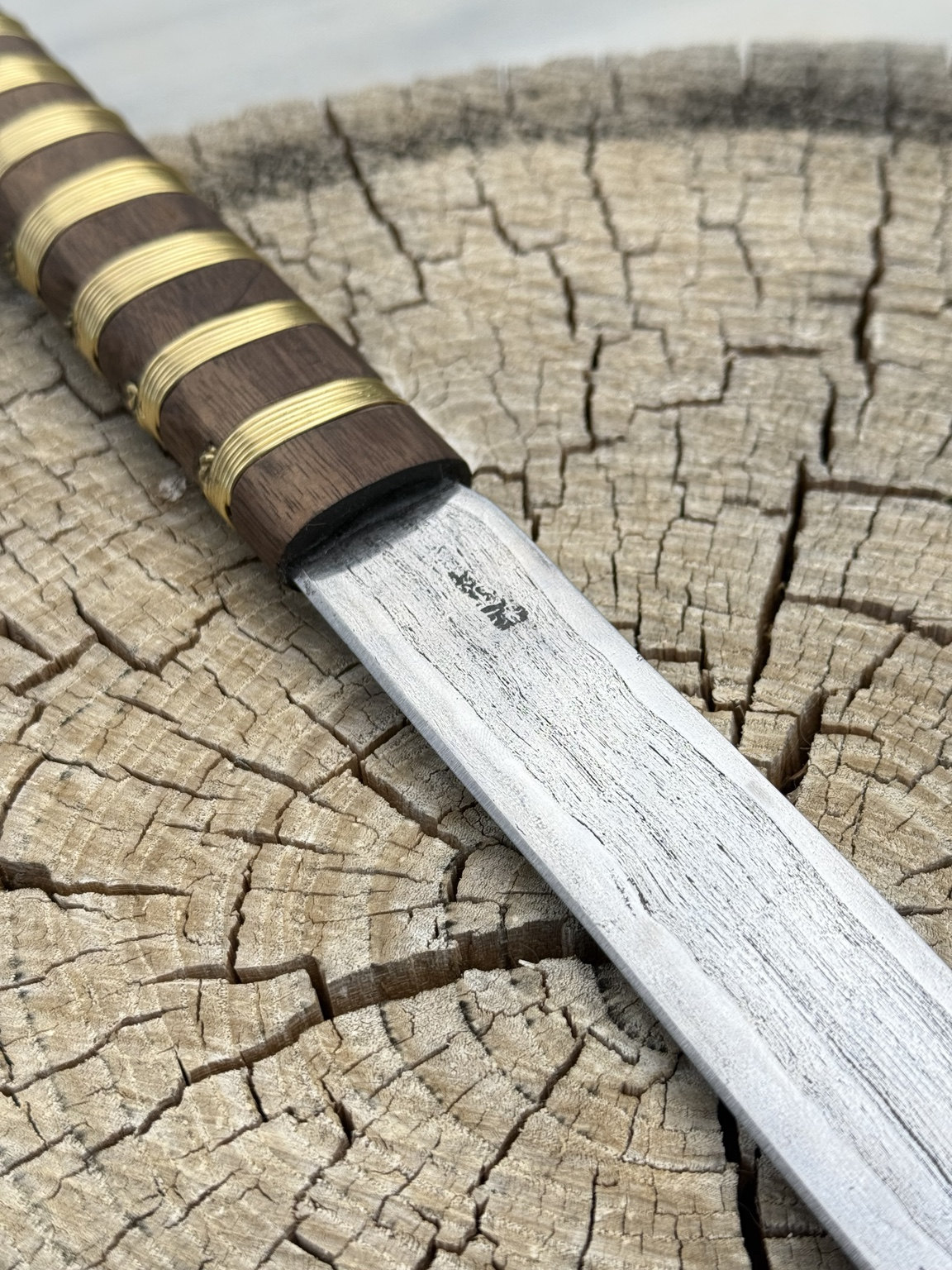
Etch: Ferric chloride revealed the contrasting steel and wrought-iron structure. I observed a hamon-like line near the edge, sometimes called an “auto hamon” by smiths. My interpretation is that it may relate to the transition between the steel and wrought iron, but I have not established its precise metallurgical cause; this remains a working hypothesis rather than a demonstrated finding.
Finished photographs
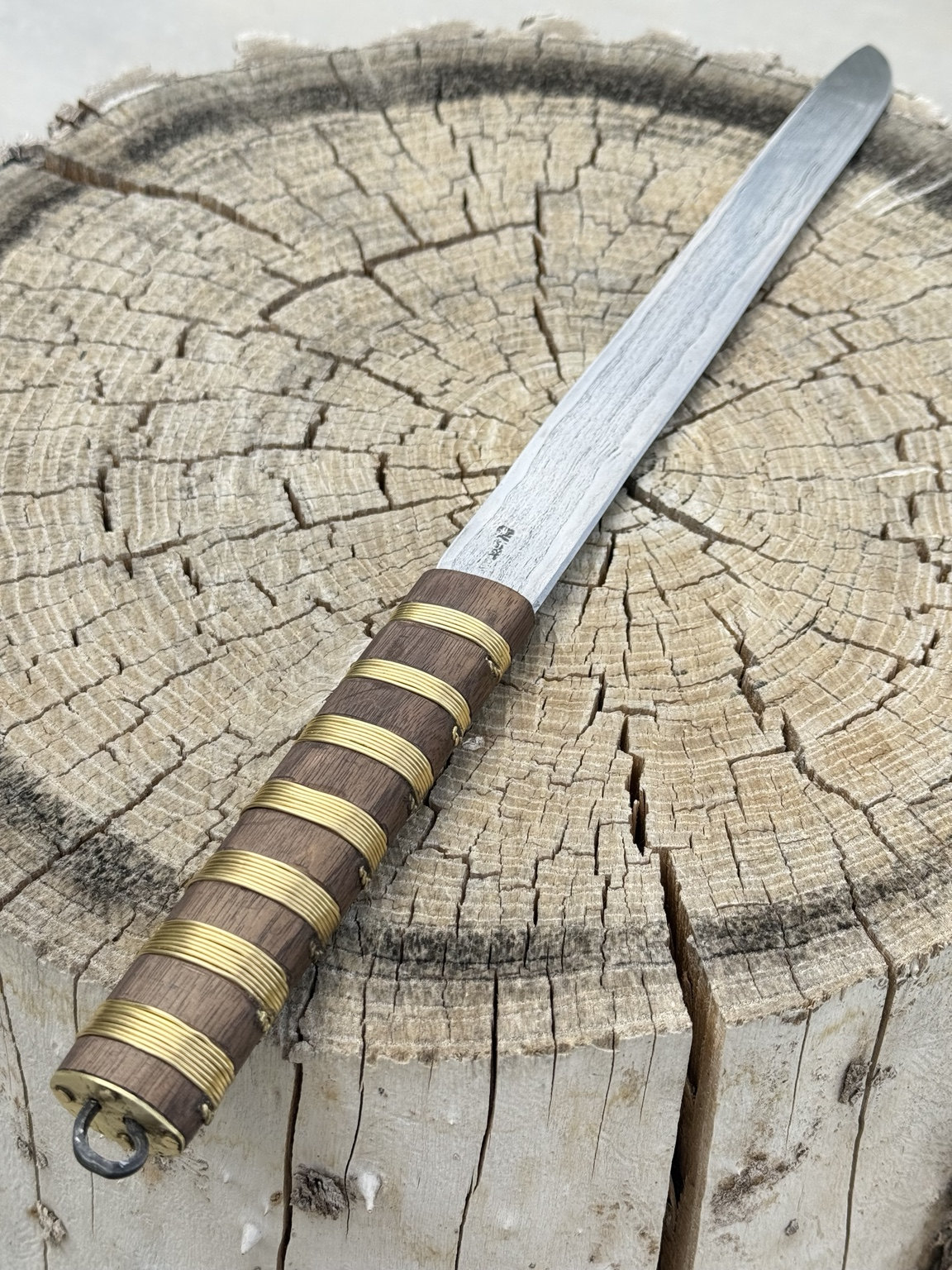
These photographs document the completed knife, including the blade's etched surface, the wire bands recessed into the oak, and the suspension ring at the butt.
Heat treatment and testing
I normalized the forged blade three times by bringing it to non-magnetic heat (estimated around 1500°F) and allowing it to air cool. This was done in the forge by eye and magnet, not in a temperature-controlled kiln, so the temperature is approximate. I then brought the blade back to non-magnetic heat, quenched in Parks AAA oil, and tempered it twice at 400°F, allowing it to cool between cycles.
A hardness file-test kit suggested approximately 55 HRC. That is an estimate from a file bracket, not a calibrated Rockwell reading. I also checked the blade for straightness after heat treatment.
Where this reconstruction differs
The finished knife preserves the historical form and some documented handle features, but several details are intentional modern choices or consequences of the process:
- Blade construction: The three-bar sword billet was reused instead of beginning with a more typical knife construction, such as an iron-backed steel-edged blade.
- Grip proportions: The 155 mm oak handle is longer than the compiled comparison range.
- Spine thickness: The blade finished at 5 mm after material was lost in the failed sword build.
- Modern materials and finish: The hardenable steel is modern 1084, the handle includes epoxy, and a ferric chloride etch accentuates the structure.
- Fittings: The brass plate and iron ring were left without the tinning that Breitenbücher described on originals he examined. I also left a forged surface texture where finer finishing would better reflect those examples.
What I learned
This was not the project I intended to make, but the change in direction forced me to use what remained of the material intelligently. It pushed my forge-welding judgment, heat control, and finishing skills. The wire-wrapped grip was my first serious attempt at that method, and it demanded greater precision and patience than I expected.
If I build another, I will set the grip length earlier, protect the intended spine thickness, and take more care with the surface finish and tinning of the fittings. I also want better hardness testing than a file-kit estimate. Documenting those departures matters just as much as documenting the parts that worked.
References
- Ottaway, P. (1992). Anglo-Scandinavian ironwork from 16–22 Coppergate (The Archaeology of York, Vol. 17, Fasc. 6). York Archaeological Trust / Council for British Archaeology.
- Tylecote, R. F., & Gilmour, B. J. J. (1986). The metallography of early ferrous edge tools and edged weapons (BAR British Series 155). British Archaeological Reports.
- Vlasatý, T. (2020). Evolution of Scandinavian long knives. Projekt Forlǫg / Sagy Vikingové. https://sagy.vikingove.cz/en/evolution-of-scandinavian-long-knives/
- Vlasatý, T. (2021). Wire-wrapped knife handles of the 9th–12th century. Projekt Forlǫg / Sagy Vikingové. https://sagy.vikingove.cz/en/wire-wrapped-knife-handles-of-9th-12th-century/
The reconstruction's measurements, choices, heat treatment, and workshop observations are drawn from my 2026 A&S documentation. Private research files are not linked here. Breitenbücher's advice is acknowledged in the text as personal communication rather than listed as a publicly retrievable publication.