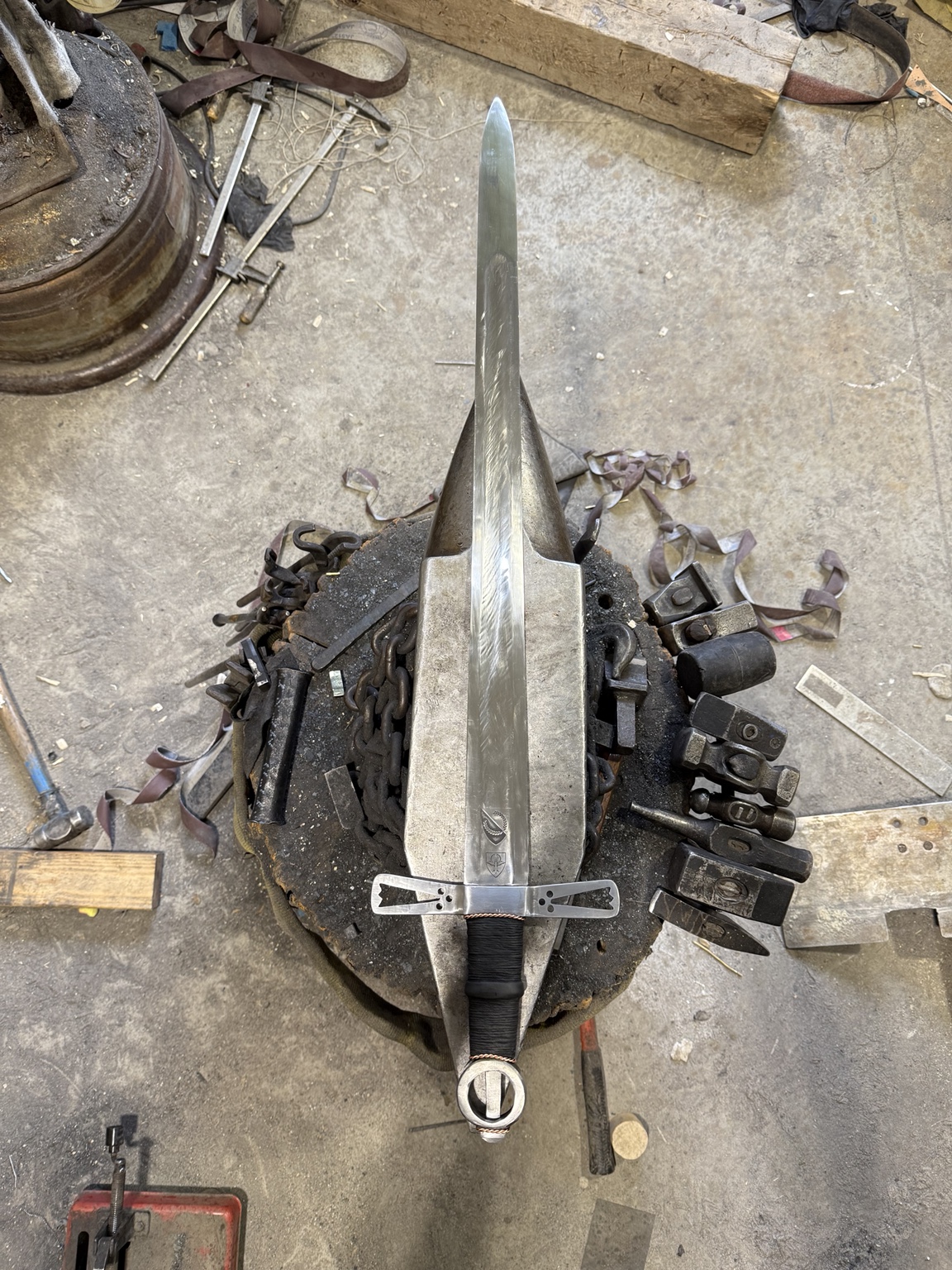
When I first started bladesmithing, one of my dreams was to make something for the Kingdom and the Society that would be part of its history. This sword gave me a chance to do exactly that.
How it began
In 2025, Duke Flóki, who was serving as Baron of Loch Salann at the time, wanted a new Sword of State for the barony. He knew I was an aspiring smith and wanted to help get my work out into the world, so he approached me about making it. In return, I offered to donate the finished sword.
That meant a lot to me. From the day I started working at the anvil, I had hoped I could make things for the Kingdom and for the Society as a whole. Being asked to create something that would be used in baronial ceremony felt like a real step toward that dream.
The sword was completed on , and delivered to the barony on .
The design and its inspiration
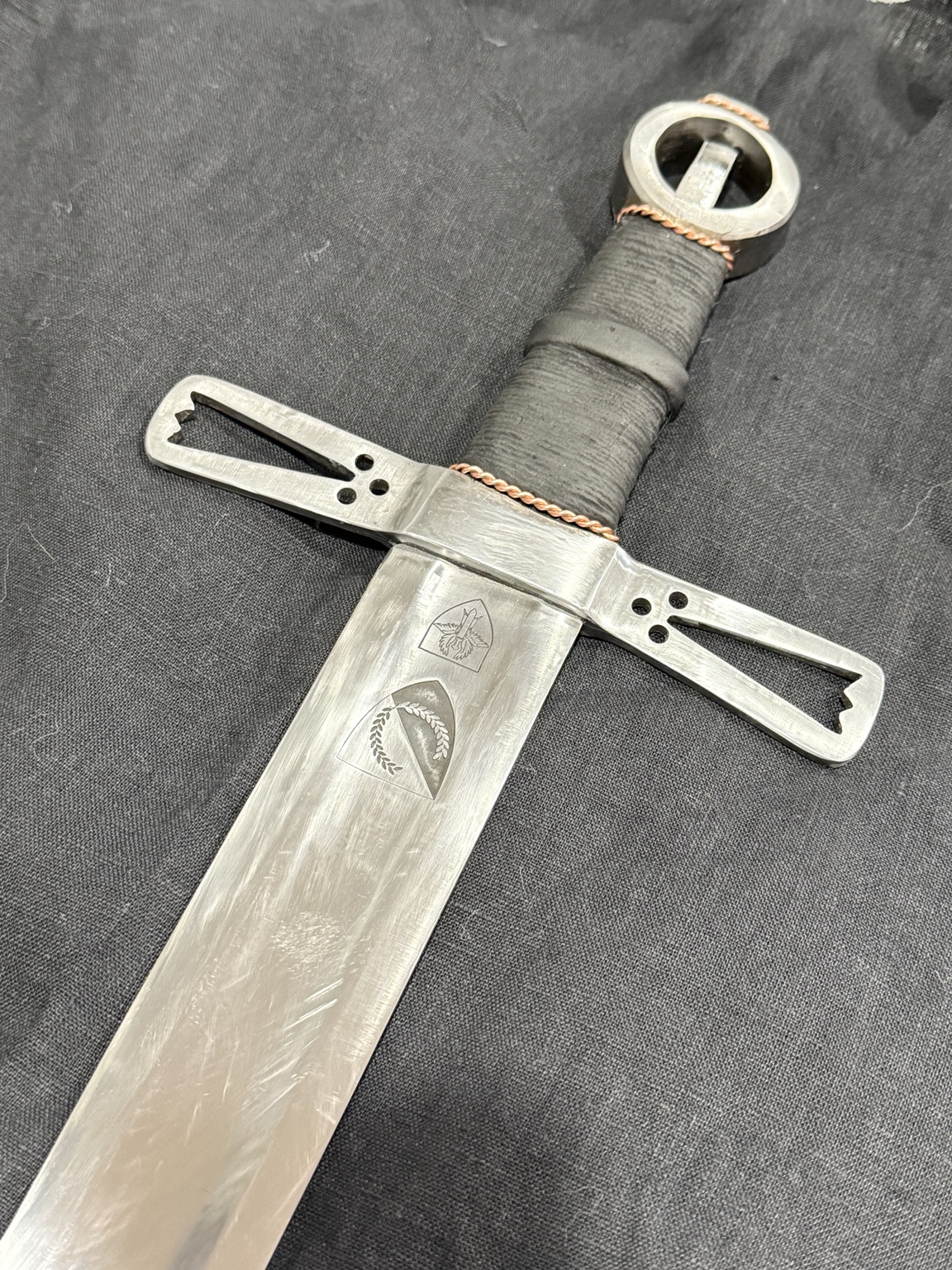
The barony chose the overall design. We wanted the general character of an Irish ring sword, not an exact recreation of a particular archaeological example. The ring at the end of the grip, the broad blade, and the distinctive guard were brought together as a ceremonial design for Loch Salann.
Historical comparison, not a reconstruction. Andrew Halpin illustrates a sixteenth-century Irish ring-pommel sword from Tullylough, County Longford, as Figure 28 on page 211 of Irish Medieval Swords c. 1170–1600 (1986). His catalogue entry, no. 31 on page 227, identifies the sword as National Museum of Ireland reference 39-1905. The archaeological example has an open ring pommel, flattened fan-shaped crossguard terminals and a comparatively narrow blade. Its recorded blade is 82.4 cm long and 3.2 cm wide.
These surviving features give useful context for the tradition that inspired the Loch Salann Sword of State. My sword was not based on the measurements or construction of the Tullylough find. Its wider blade, pierced heraldic guard and other ceremonial details were chosen for the barony rather than copied from an archaeological original.
Source: Halpin, Andrew (1986), Irish Medieval Swords c. 1170–1600, Proceedings of the Royal Irish Academy 86C, 183–230, fig. 28 (p. 211) and catalogue no. 31 (p. 227). View the published study. The historical drawing is not reproduced here.
Forging the blade and hilt
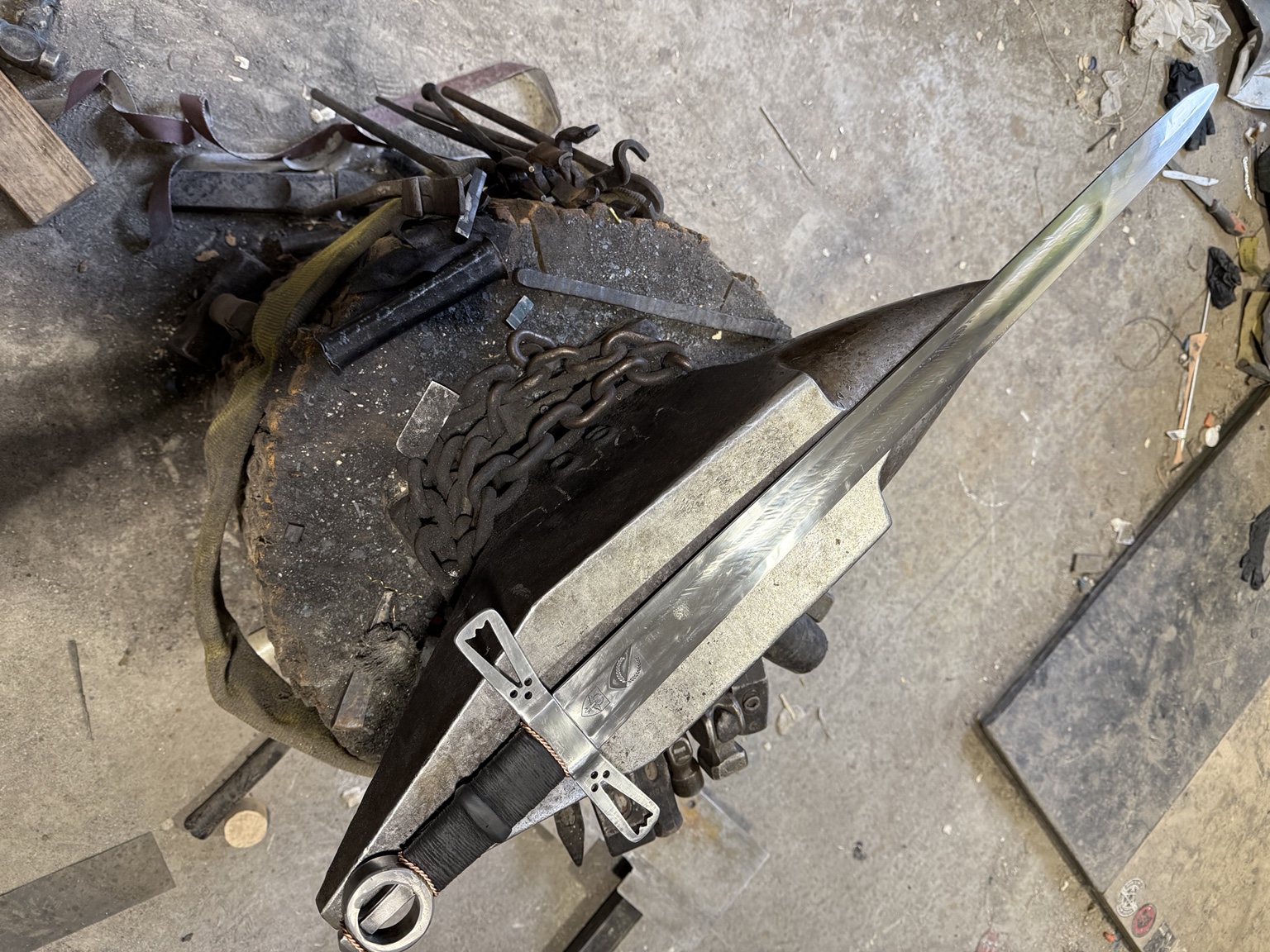
I forged the blade from 80CrV2 steel. It is approximately 762 mm long and 51 mm wide at the shoulder. I no longer have the rest of my measurements or a detailed build log, so the construction record here is based on what I remember rather than an attempt to fill in every gap.
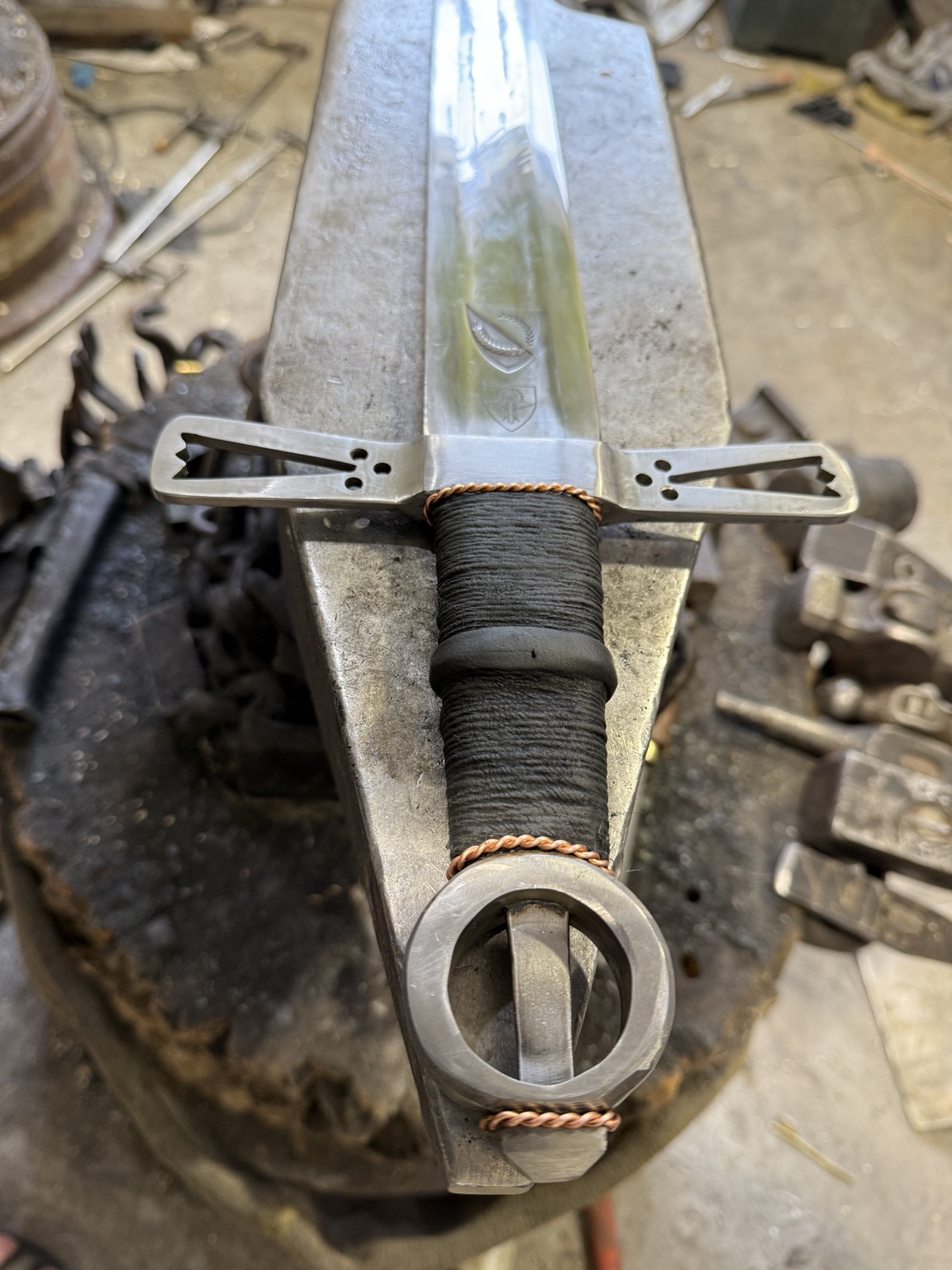
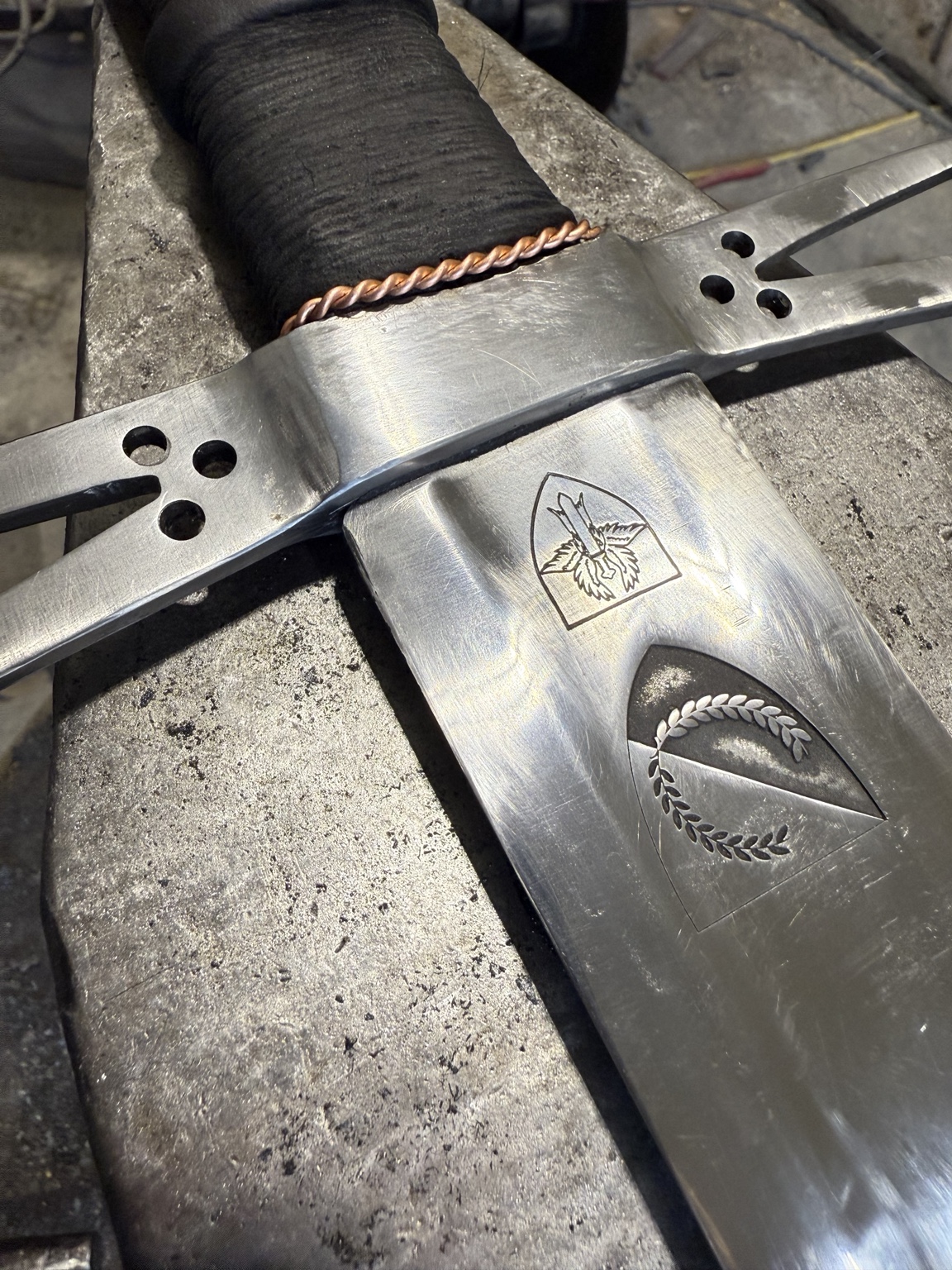
The guard started as a basic square section of modern mild steel. I hot-fitted the opening to the tang and shoulders of the blade, then, with the guard still on the sword, I forged the two wings out into shape. Once those were where I wanted them, I used a drill and hand files to cut the heraldic details into the ends.
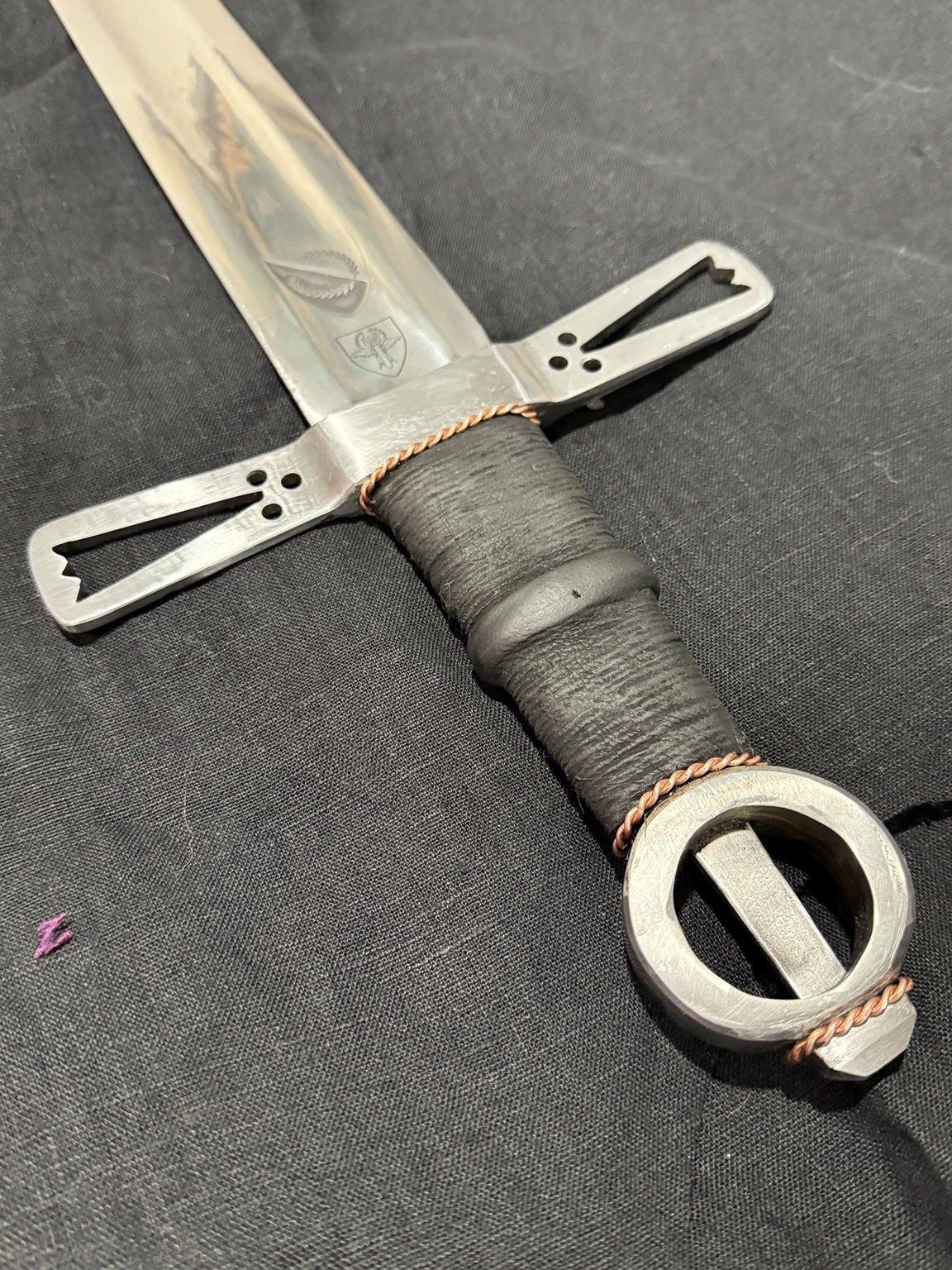
The ring pommel was made from round mild-steel stock. I drilled an opening, then used hot-punching and a hand file to fit it to the tang. The tang passes through the hilt and is peened at the end of the ring to secure everything together. The handle has a pine wood core wrapped in thin black deer hide, with twisted copper-colored wire accents.
A sword for the entire barony
One of my favorite parts of the design is the heraldry. As it was explained to me, the baronial arms include a divided shield with a laurel wreath, while the populace badge uses counterchanged ermine spots. Those ermine spots are the shapes I pierced through the wings of the guard. They are a heraldic motif, not quills or feathers.
The history was explained to me as a way for the populace to have its own badge, distinct from the baronial arms. To me, putting those ermine spots on the sword meant this would not just be the baron and baroness's sword. It would belong to everyone in Loch Salann. That is my interpretation of the symbolism, but it is an important part of why I like this piece.
The heraldic devices on the blade were laser engraved by Nicholas Cochiolo, and I want to make sure his contribution is recognized.
The pressure of getting it right
The most difficult part of the build was trying to make everything perfect. I had not made many swords up to that point, and this was a real opportunity to contribute my work to the Society. It put a lot of pressure on me, in a good way, but it was still stressful. I wanted the sword to be worthy of what it was going to represent.
At the time, this was the most extensively decorated hilt hardware I had made. Finishing it showed me I could push my skills farther than I had before, and I am still proud of how it came together.
What I would change today
If I made it again, I would take more time fitting the ring pommel to the tang. It is secure, but there are a few small gaps I would like to minimize. I also would spend more time heating and finishing the peen at the end of the tang.
I would make the handle a little narrower as well. It is slightly wider than I would prefer now, and thinning it out would improve the feel in the hand. Those are the sorts of details I notice as my experience grows, even on a sword I am proud of.
What it means to me
What matters most to me is knowing I made something that could last the barony a lifetime. This is a sword people can swear their oaths on. It can become part of Loch Salann's history and be passed from one set of baronial hands to the next.
Finishing it was a dream come true, and it was a major stepping stone in my confidence as a smith. When I began this adventure, this was exactly the kind of work I hoped I could someday do.